
Avery VINELink Release Coverage
NC SAVAN is North Carolina’s Statewide Automated Victim Assistance and Notification system, delivered through VINELink. The North Carolina Department of Adult Correction says it includes county jail inmates, state prisoners, probationers, parolees, and registered sex offenders. Registration is free and confidential, with phone, email, text, and TTY channels documented by the state.
That breadth does not combine the underlying records. An Avery County jail entry comes from the local custodian. A state-prison record comes from DAC. A supervision entry describes a person in the community under probation, parole, or post-release supervision. A registry result applies only to a person with a legal registration duty. Read the agency, custody category, facility, and update information before interpreting the status.
| Record type | VINELink role | Confirm with |
|---|---|---|
| Avery county jail | Custody status and change alert when an agency record is available | Avery Detention Center and the court case |
| North Carolina state prison | State custody, transfer, projected event, or release notice | DAC offender detail and history |
| Community supervision | Probation or parole-related status in NC SAVAN coverage | DAC supervision history and assigned office |
| Federal prison | Not the primary historical locator | BOP Inmate Locator |
Search One Avery Person on VINELink
Open the official North Carolina VINELink search and search for one person. Use an agency identifier when known. With a name, begin with the legal last and first names, then use age, facility, or other displayed details to separate similar results. A name match alone is too weak, especially when multiple bookings or spelling differences appear.
- Select North Carolina, then choose the custody or offender search that fits the last known custodian.
- Enter the last and first name or the available booking or offender identifier.
- Compare age, facility, agency, and other identifiers across candidate results.
- Open the correctly matched record rather than relying on a brief results row.
- Read the exact custody status, location, event date, and update information.
- If the record says released or out of custody, save the date if supplied and confirm with the originating agency when the precise type matters.
The official VINELink North Carolina screen is the manifest-matched search source for this Avery County workflow.
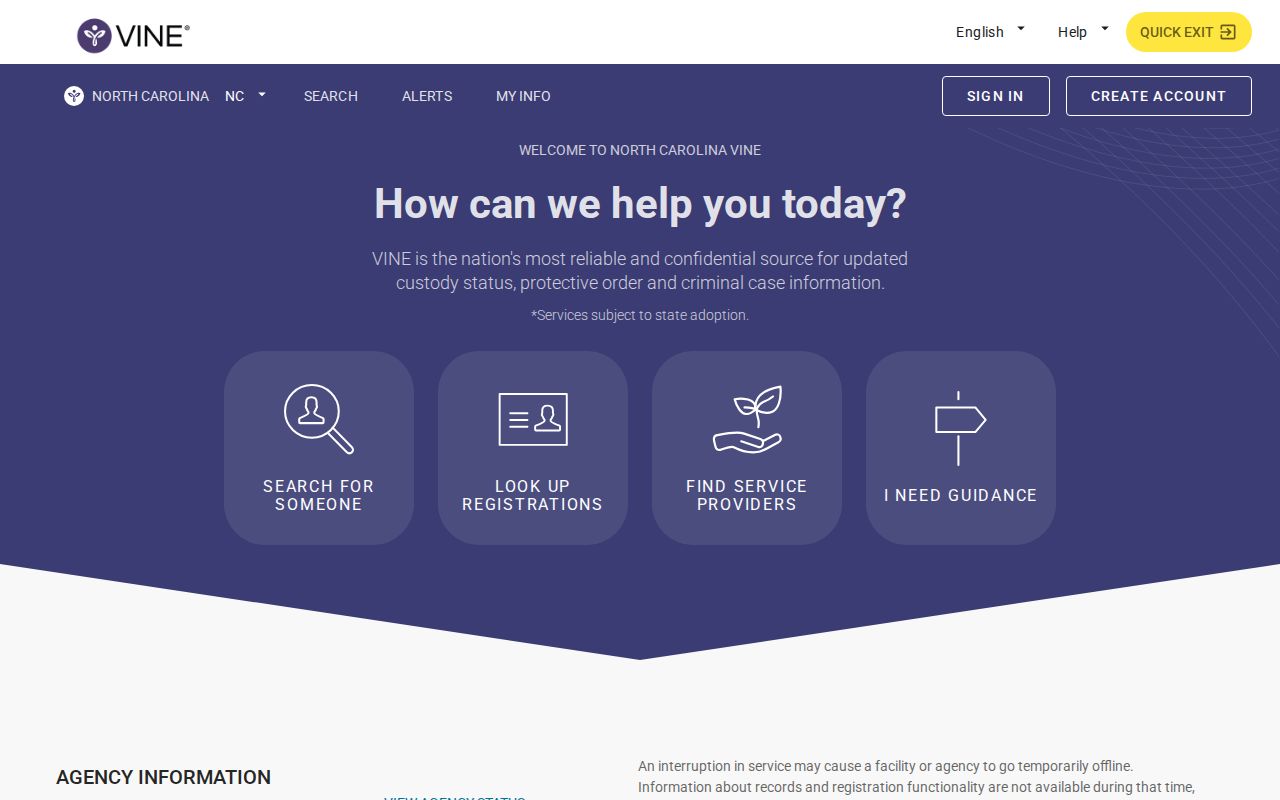
The state selection and matched agency record determine which custody system the displayed result describes.
What Avery VINELink Results Show
A VINELink result normally identifies the person, source agency, custody status, and facility or location supplied by the participating system. A released result indicates that the feeding agency marked the person out of that custody. It may include a date, but it may not state the legal reason, destination, court disposition, or whether another agency immediately took custody.
| Field | How to read it |
|---|---|
| Name and identifier | Use both to reduce the risk of a mistaken identity. |
| Custody status | Preserve the exact terms, such as in custody, released, or out of custody. |
| Agency or facility | Shows which record source owns the event. |
| Event or update date | Shows timing in the notification feed, not always a certified transaction time. |
| Release date | When present, verify whether it is projected or actual. |
| Notification option | Allows registration against the matched custody record when offered. |
A transfer can move someone out of the Avery jail while leaving the person in custody elsewhere. Likewise, release from Avery-Mitchell or Mountain View can lead to post-release supervision rather than final discharge. Use the record’s own wording. Do not turn “not found,” “not at this facility,” or a facility change into “free.”
Note: Match at least two identifiers and record the retrieval time because an Avery County custody status can change after the search.
Register for Avery Release Alerts
Registration works best before release, while the person remains linked to the correct custody record. Open that matched record and use the live “Register for Notification” control or its current equivalent. Interface wording may change. Follow the prompts shown rather than assuming that every channel uses the same confirmation method.
- Select the notification option on the correctly matched person record.
- Choose an offered channel: telephone, text, email, or TTY.
- Enter and confirm the phone number or electronic destination.
- For telephone notices, create the requested four-digit PIN and keep it available.
- Complete the email or text verification shown by the interface. Those channels do not necessarily use the phone PIN.
- Save the registration confirmation and update the contact information if it changes.
North Carolina’s official SAVAN material says the phone user enters the callback number with area code and creates a memorable PIN. During an alert call, entering the PIN acknowledges receipt and stops repeat calls. If there is no answer or no PIN, calls may repeat at set intervals for up to 24 hours. The statewide line is 1-877-NC-SAVAN, or 1-877-627-2826.
If the person is already marked released, the custody record may have no future release event to send. The result can still be a lead for verification, but registration cannot recreate an alert that already occurred.
Avery SAVAN Events Need Context
Official NC SAVAN policy describes several state-prison triggers. They include a projected release date after admission audit, release with supervision, release without supervision, escape and capture, minimum custody, death, and home leave. The separate release-with-supervision and release-without-supervision events are important. Leaving a prison building and completing all correctional control are not the same milestone.
A projected release notice is also not an accomplished release. Sentence correction, court action, credit calculation, disciplinary consequences, a new sentence, revocation, or another lawful change can move the date. Pair a projected alert with the official DAC detail, then return after the event to look for actual history. The Avery inmate release date page explains those North Carolina computation rules.
- Projected release
- A future date based on the sentence and credits then recorded.
- Release with supervision
- Departure from prison followed by continuing DAC community control.
- Release without supervision
- A distinct SAVAN event that still must be confirmed in agency history.
- Transfer
- Movement between custodians or facilities, not release to the community.
Why Avery Needs NC SAVAN
Avery County’s official Sheriff’s Office page is contact-centered and does not expose a verified public recent-release feed. That makes NC SAVAN especially useful as a notification layer for one named person. It can provide a custody-change signal when there is no county 24-hour or 72-hour archive to browse. Yet SAVAN remains a notification service, not an official Avery release sheet.
For a county-jail event, call the Avery County Sheriff’s Office and Detention Center with the full name, date of birth if known, and booking or case number. Ask whether the person remains held and whether the public booking record shows the actual release date, time, type, and transfer destination. If exact proof matters, request the release fields in writing and compare them with the Avery court case.
For a state prisoner, pair the alert with the DAC offender search. Read incarceration and supervision histories. The former prison alone cannot show whether the person transferred, entered community supervision, or reached final discharge.
Avery VINELink Limits and Confirmation
VINELink feeds can lag. Multiple bookings, name collisions, transfers, and changes in the source system can complicate a result. A notification is valuable for timing, but it does not supply every legal detail. When a court deadline, release type, or exact destination matters, confirm with the office that created the underlying custody record.
For a federal sentence, use the BOP Inmate Locator. For immigration custody, use ICE only when an Avery release or another official source identifies that handoff. No match in either system does not prove release. A county jail disappearance also does not place the person in DAC unless an official record shows the transfer.
For an Avery jail detainee, confirm with the sheriff and court. For a North Carolina prisoner, confirm with DAC. For active probation, parole, or post-release supervision, use the assigned Community Supervision office. That source-by-source check preserves the difference between a notification, an actual release transaction, and final sentence discharge.
Follow Up on Avery Release Alerts
Keep registration tied to the right person and agency. If two records share a name, compare age, identifier, location, and custody source before saving an alert. A later booking may create a new record that is not covered by an older registration. Contact details should stay current, and a saved confirmation helps show which record and delivery channel were selected.
Alert timing should not control a court filing or another deadline. A phone may be unavailable, a text or email may be delayed, and a source-agency update may reach SAVAN after the physical event. Use the alert as a prompt to check the sheriff, DAC, or court. When the person’s status affects immediate personal safety, follow an official safety plan or contact the proper public-safety office rather than waiting for one electronic message.
A released result has a narrow meaning. It shows that the feeding agency marked the matched person out of that custody. It does not state that every charge ended, all sentences expired, no detainer exists, or the person reached a certain destination. Ask the originating custodian for the public release type and transfer notation. Then use the court judgment or DAC history to explain the legal event.
For an Avery jail record, note whether the result names the sheriff or another county source. For a state record, retain the DAC offender number. Those identifiers make the follow-up request precise and reduce the chance of mixing two people or two custody episodes.