
Avery Parole and Probation Compared
North Carolina records separate several forms of community supervision. Probation usually results from a suspended or community sentence entered by a court. It does not prove that the person served a state-prison term. Parole applies mainly to legacy or specially eligible sentences. Post-release supervision is a statutory period that starts after release from a Structured Sentencing felony prison term and before the maximum term ends. Field supervision for all three is handled by the North Carolina Department of Adult Correction Division of Community Supervision and Reentry.
| Status | How it starts | What release means |
|---|---|---|
| Probation | A court imposes community supervision, often with an active sentence suspended. | The person may never have entered state prison. |
| Parole | The Commission grants conditional release for an eligible sentence. | Prison custody ends, but parole conditions remain. |
| Post-release supervision | Article 84A applies after a qualifying felony prison term. | The person leaves prison before the maximum term expires. |
The exact DAC label controls. “Released from prison” should not be restated as “sentence complete” when supervision remains active. A county-jail bond release is different again. It does not create parole or post-release supervision, though a judge may order probation when the case reaches judgment.
- Discharge
- The legal end of the recorded supervision term.
- Absconder
- A person alleged to have stopped required contact or left an approved location.
- Revocation
- A formal action that can return a supervisee to confinement.
- Detainer
- A request or order from another authority affecting custody or release.
Verify Avery Post-Release Supervision
The official starting point is the DAC Offender Public Information Search. It covers North Carolina state prisoners, probationers, and parolees, with history reaching back to 1972. It does not contain county-jail-only records. Search with an offender number when possible because names can collide. A released Avery County person can remain visible as an active probationer, parolee, or post-release supervisee.
- Enter the offender number, or search by name and use age and other displayed identifiers to narrow the results.
- Open the person detail and match more than the name. Compare offender number, conviction county, offenses, and dates.
- Read the top-level status, then open supervision history. Record the exact type, start date, status, and termination date if shown.
- Use the Community Supervision office directory to identify the office tied to the record.
- Contact that office only for current reporting or status questions. Confirm an actual prison release in incarceration history.
The broader DAC criminal searches page also links specialized absconder and release searches. The full county-jail, court, and state-record path appears in the Avery released-inmate search.
The official directory is the source for finding the office assigned to Avery County supervision records.
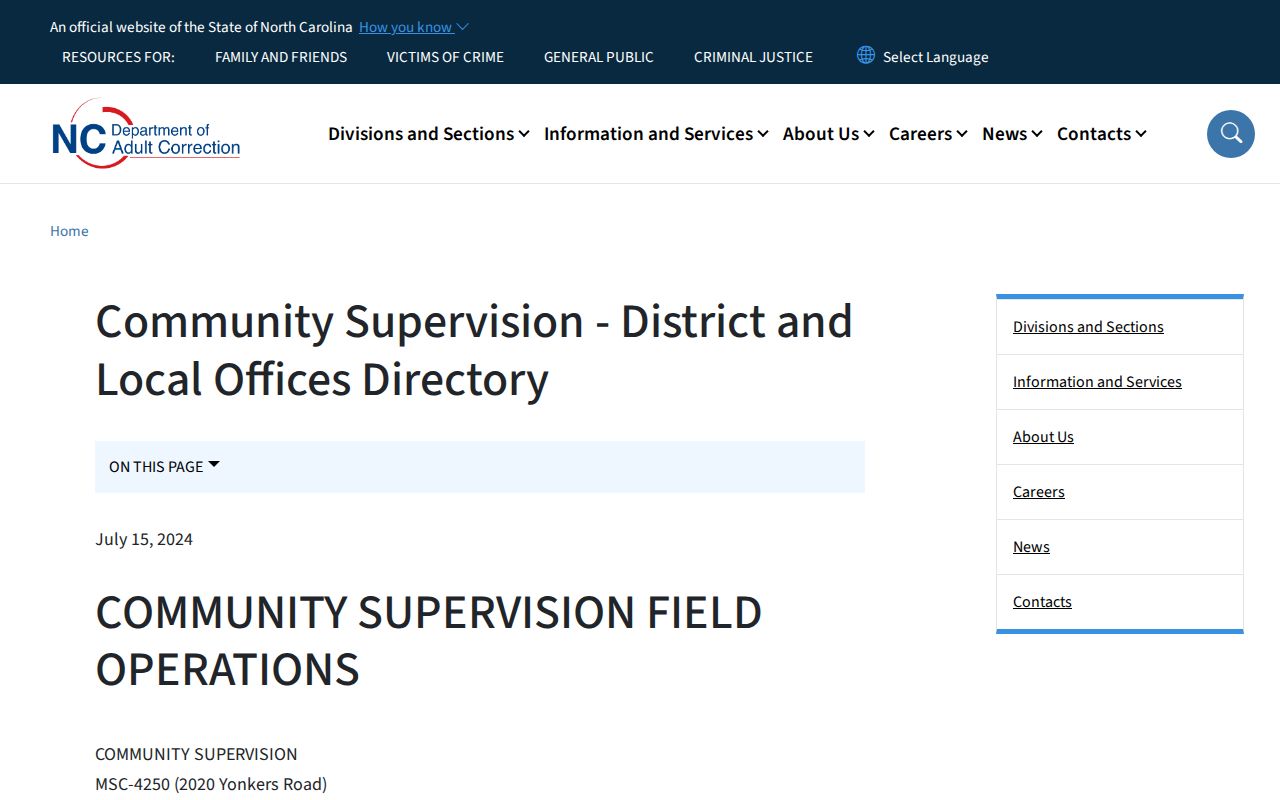
Use the current directory entry rather than assuming either Spruce Pine prison is the reporting site.
Avery Supervision District Lookup
Avery shares a DAC Community Supervision district with Madison, Mitchell, Watauga, and Yancey counties. That multi-county structure matters. A person released from Avery-Mitchell Correctional Institution or Mountain View Correctional Institution may report to a local or district office based on the official assignment, not to the former prison. District personnel, boundaries, phone details, and local entries can change, so the live directory should settle the route each time.
Avery, Madison, Mitchell, Watauga, and Yancey district
Current district and local office directory
Call only the office shown for the person’s current assignment. Office staff can address reporting logistics, but a prison’s old location does not establish the supervision office. For an Avery County probation order, the court file can explain the sentence while DAC history supplies the active field-supervision status.
Avery Prison Reentry Connections
DAC designates Avery-Mitchell Correctional Institution as a reentry facility. Its official description says the prison works with local reentry councils to connect people with resources before transition. That fact applies to people leaving the state facility. It does not establish a county-run program for someone released from the Avery County Sheriff’s Office and Detention Center.
Reentry planning and legal supervision serve different roles. A local council may help with transition needs, while DAC Community Supervision enforces the conditions recorded for probation, parole, or post-release supervision. A person may use reentry services without being under supervision, and a supervisee may be assigned to an office outside the county of the former prison. Keep the DAC status, assigned office, and service provider separate.
Note: Avery-Mitchell’s reentry role does not turn the prison into the reporting office for a person released under community supervision.
Avery Violations and Absconder Records
The North Carolina Post-Release Supervision and Parole Commission establishes post-release conditions and decides revocation and re-release questions. At a high level, conditions require compliance with the terms set for that person. A reported violation may lead to continuation, changed conditions, confinement, or revocation under Article 84A. The outcome must come from the official record rather than an assumption based on an earlier release.
DAC uses “absconder” for an alleged failure to remain in contact or at the approved location. That label is not a new conviction. It also should not be converted into a claim about the facts behind the alleged breach. Check the dedicated absconder search, the current supervision record, and any public Avery court case tied to a warrant. A formerly released person may return to custody, which is why every supervision check needs a retrieval date.
NC SAVAN through VINELink can provide notices for custody changes, and its statewide scope includes probationers and parolees. It is an alert service, not the source for interpreting a violation or proving final discharge.
Avery Parole Reviews Are Monthly
Most North Carolina offenses committed on or after October 1, 1994 fall under Structured Sentencing and are not ordinary discretionary-parole cases. DAC says earlier offenses may remain parole eligible, subject to exclusions and special programs. The central eligibility law is G.S. 15A-1371. Offense date and sentence type must be checked before looking for a parole review.
North Carolina does not publish a standard person-by-person calendar of future formal parole hearings. Commission analysts review files, and commissioners vote independently. The official Monthly Discretionary Parole Reviews page posts decision reports beginning with September 2024. A review listing is not a public oral hearing. Possible official actions include grant, deny or refuse, defer, rescind, revoke, and terminate, but the report’s own term should be preserved. A favorable action is not proof that the physical release has happened.
The monthly report page shows the official cadence and links to decision PDFs.
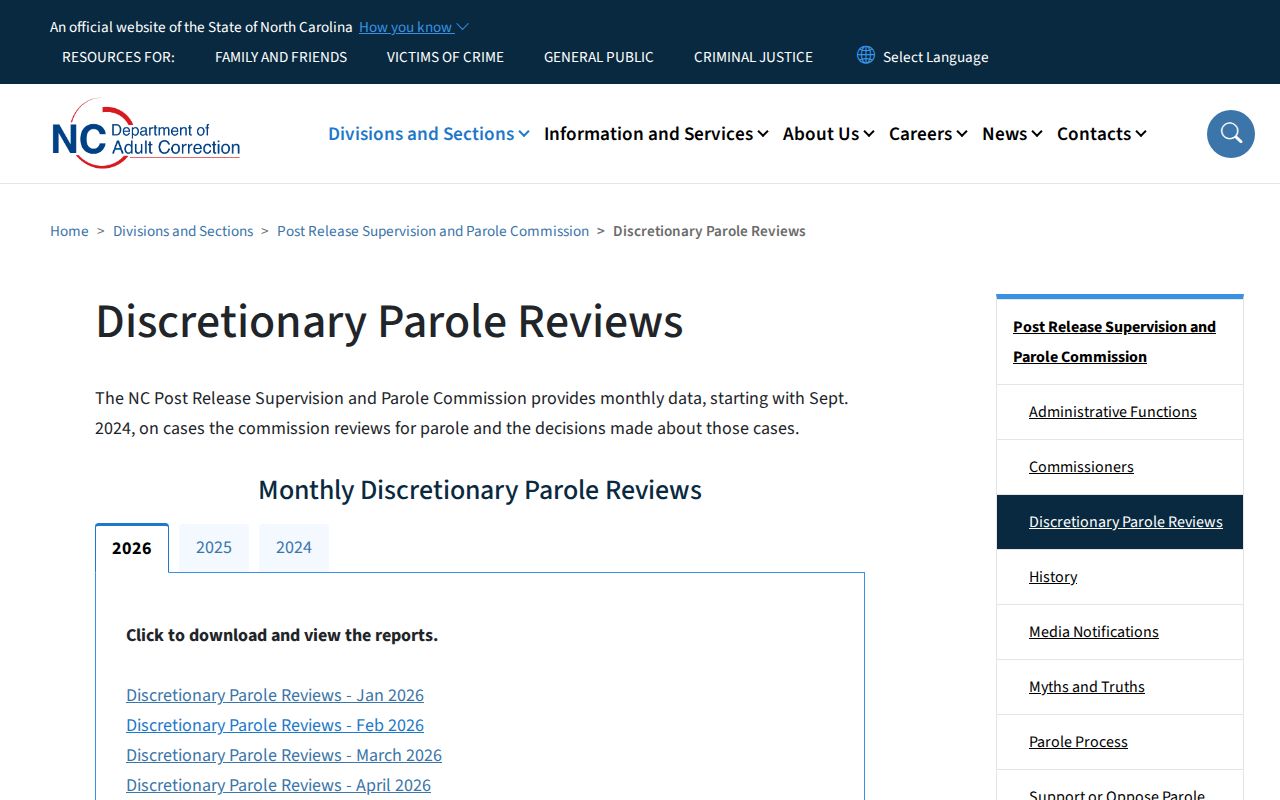
Confirm any release through the person’s DAC incarceration history after reviewing the Commission report.
How Avery Supervision Ends
Release from a prison gate and discharge from correctional control are separate events. Under Article 84A, post-release supervision is time outside prison before the maximum term ends and remains subject to Commission control. G.S. 15A-1368.2 generally sets release to supervision at the maximum term less the statutory supervision portion and earned time. That framework explains why an actual release date and a final sentence end date differ.
The DAC record may show a projected or actual supervision termination date. Treat a projected date as tentative until history records the completed event. For probation, the court judgment and DAC supervision history should agree on the type and term. For legacy parole, Commission action and DAC history should be read together. A transfer, office change, or inactive display must not be treated as final discharge without supporting history.
North Carolina public-record law permits access to many agency records, but sealed, expunged, juvenile, medical, security-sensitive, and protected personal information may be restricted. Save the offender number, exact status label, retrieval date, and official source. Those details preserve what the record actually said without enlarging the claim.
DAC status terms also need to be read in sequence. An active community-supervision label supports that the person is outside prison under the named form of control at that time. An inactive label means the person was formerly active as an inmate, probationer, or both, but detailed history is still needed to identify when each period ended. Neither label proves an Avery County jail stay. County-jail-only detention remains with the sheriff and the related court case.
When dates conflict, compare the court judgment, incarceration history, supervision history, and Commission action without forcing them into one event. A prison release date may start post-release supervision. A later termination date may mark discharge. A revocation can create another confinement period, followed by re-release. Each entry answers a different question. The sound statement is narrow: the person was released from the recorded custodian on the recorded date and had the supervision status shown when checked.
Avery County’s two nearby state prisons can make the source easy to confuse. The facility name identifies where someone was held, while DAC’s statewide offender number connects the sentence, release, and supervision entries. Community Supervision, not Avery-Mitchell or Mountain View, handles field reporting after release. For a person whose record never entered DAC, use the Avery judgment and county detention record instead.