
Avery Projected and Actual Release
A projected release date answers a forward-looking question: based on the sentences and credits now recorded, when should custody reach its next statutory release point? It does not certify that release occurred. The projected event can be release from prison into post-release supervision rather than final discharge of the sentence. An actual release date is historical. It records an event after the custodian processes it.
The distinction changes where an Avery County search begins. A sentenced person held by the North Carolina Department of Adult Correction may have a projected field in the official offender detail. A person awaiting trial at the Avery County Sheriff’s Office and Detention Center does not have a sentence-based date. Bond action, dismissal, a court order, another hold, or later judgment controls that custody. A person serving local confinement requires the judgment and the jail’s own credit calculation, not a state-prison formula.
Transfer also needs care. Movement from the Avery jail to DAC, another county, federal custody, or another agency means the person left that building but remained in custody. Likewise, movement between Avery-Mitchell and Mountain View does not create a new sentence or prove release.
Find an Avery Inmate Release Date
Start with the last known custodian. For a state-prison sentence, use the DAC Offender Public Information Search. It accepts a name or offender number, covers state prisoners and community supervision, and excludes county-jail-only stays. The direct state Inmate Release Search can find completed DAC releases by county, month, year, or last name, but it is not an Avery jail feed.
- Read the court judgment and note the sentence’s effective date, minimum and maximum terms, and whether terms run together or one after another.
- Search DAC by offender number when available. Otherwise match name results with age, conviction county, offense, and dates.
- Open the detail and copy the projected field exactly as labeled, including any “as of” context.
- Review sentence and incarceration histories for multiple terms, new admissions, revocations, and actual prior releases.
- Determine whether the next event is prison release to supervision or the final discharge of all correctional control.
- Recheck near the date. After it passes, look for the actual transaction and status rather than relying on the old projection.
The image below comes from the official DAC offender search used for Avery County state-prison records.
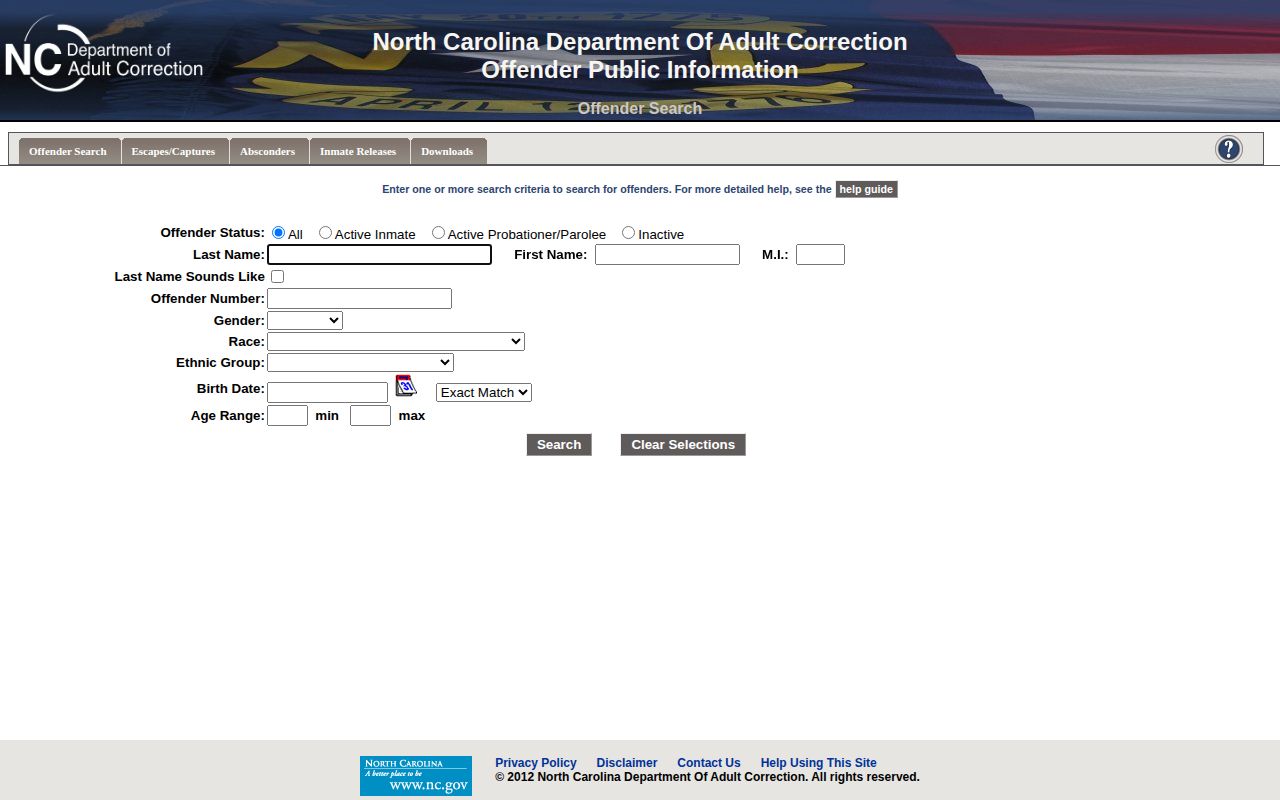
The search result must be opened and matched carefully before any projected or actual release field is attributed to a person.
Avery Structured Sentencing Dates
North Carolina Structured Sentencing starts with the minimum and maximum terms imposed by the court. Under G.S. 15A-1340.13(c), an imprisoned felon must serve the minimum term, which generally cannot be reduced by earned time. Subsection (d) allows earned time to reduce the maximum. When the maximum less earned time reaches the minimum, release to post-release supervision occurs if Article 84A applies.
The popular “85 percent” phrase is not a fixed promise in North Carolina law. Structured Sentencing maximum terms include time above the minimum, and common examples can yield a similar ratio. Yet offense class, sentence date, concurrent or consecutive structure, special statutes, earned credits, and the supervision term all matter. The DAC displayed date and the governing judgment control the individual Avery County calculation.
The official statute page shows the minimum-term rule and how earned time affects the maximum.
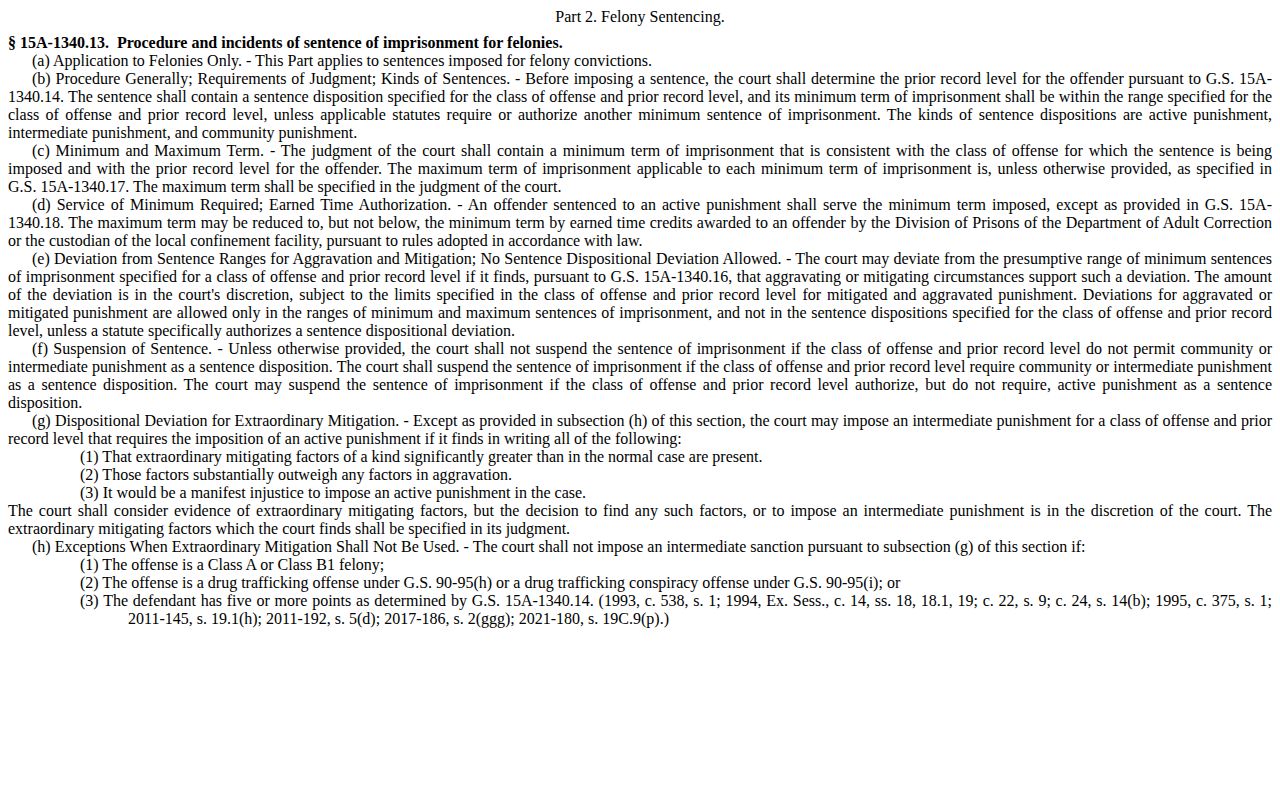
Read the statute with the offender’s judgment and DAC history instead of turning a general ratio into a guaranteed release day.
Avery Earned Time and Jail Credit
G.S. 148-13 authorizes DAC rules for custody grades, privileges, gain or earned time, and credit forfeiture or restoration. Credits depend on lawful classification and conduct. They cannot be forecast with confidence from outside the agency. The public projected date reflects the information recorded when the system calculated it, not a promise that all future credits will remain unchanged.
Jail credit for time already spent in confinement is governed separately, including G.S. 15-196.1 through 15-196.4. A corrected jail-credit entry can change the projected date without changing the sentence imposed. For an Avery County misdemeanor or other local confinement sentence, obtain the filed judgment and ask the custodian how jail credit and any authorized local credits were applied. Do not copy the DAC felony projection method onto a county sentence.
- Earned time
- A credit administered under DAC rules that can reduce the maximum term as law allows.
- Jail credit
- Credit for qualifying time already spent in confinement.
- Minimum term
- The sentence portion a Structured Sentencing felon generally must serve.
- Maximum term
- The longer term used with credits and the statutory supervision framework.
Note: A credit estimate from a sentence length alone cannot replace the value displayed in the current official record.
Avery Release Into Supervision
Article 84A governs post-release supervision. G.S. 15A-1368.2 describes the usual supervision subtraction from the maximum: twelve months for Class B1 through E felonies, nine months for Class F through I felonies, and sixty months for certain sex-offense maximums under G.S. 15A-1340.17(f), less earned time. Those figures explain why the projected prison-release point can occur before the maximum sentence date.
A person released from Avery-Mitchell or Mountain View may therefore be outside the institution but still under DAC control. The offender detail should be read for both incarceration history and community-supervision history. A projected prison release does not establish the later supervision discharge. The Avery parole and probation record path explains how to verify the assigned status and office once the release event occurs.
The official Article 84A source shows that release with supervision and final sentence completion are separate statutory milestones.
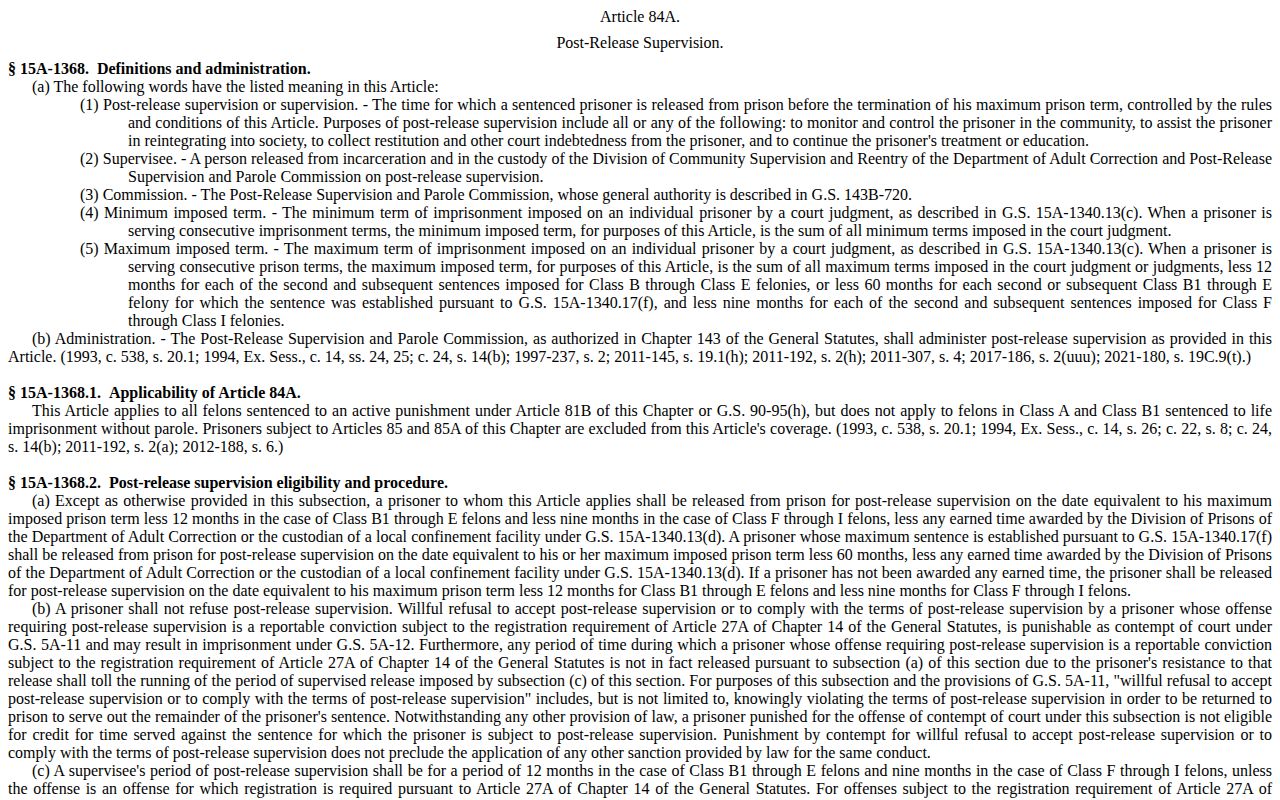
Use the date label and status together so a prison release is not misstated as an unconditional discharge.
Why Avery Release Dates Change
A projected date can move because the legal or administrative inputs change. The cause should be supported by the judgment, DAC history, or another official entry. A new date alone does not show which factor caused the change.
| Factor | Possible effect | Where to verify |
|---|---|---|
| Jail credit correction | Changes time already credited toward the term. | Judgment, commitment, and DAC sentence history |
| Amended judgment or appeal | Changes the lawful sentence or its effective terms. | Avery court file and updated DAC record |
| Consecutive sentence or new sentence | Adds a term that must be served in sequence. | Sentence history and filed judgments |
| Credit forfeiture or restoration | Moves the maximum-term calculation. | Current DAC calculation |
| Revocation or escape time | Changes custody history and the remaining term. | DAC incarceration and supervision histories |
| Data correction | Fixes a prior administrative entry. | Updated official detail or DAC records response |
A detainer from another authority may also prevent release to the community even when one sentence reaches its projected point. The person can be transferred to the requesting agency. That outcome is a custody transition, not proof of freedom from all holds.
Avery County Jail Release Timing
A local jail date calls for a different calculation. The Avery detention record proves when the custodian processed a release, while the filed court record explains the legal basis. A bond order can authorize release while the criminal case stays open. A judgment can impose time served or a local term. Another warrant or detainer can keep the person in custody even after one case reaches its expected end.
Ask for a defined record rather than a forecast made from the charge alone. Give the full legal name, date of birth if known, booking or case number, and approximate custody dates. Request the actual release date and time, release type, and any public transfer destination. Then compare the answer with the judgment, bond order, dismissal, or commitment in the Avery court file. Administrative processing can separate the time of a court event from the time the jail completes release.
North Carolina public-record rules allow focused requests for many agency records, subject to statutory limits. They do not turn a pending case into a fixed release schedule. Juvenile, sealed, expunged, medical, security-sensitive, and protected identifying material may be restricted.
Confirm Avery Release Near the Date
For a person at the Avery County jail, call the detention center and use the court case to confirm the order, judgment, or bond event. Ask for the actual release date, time, type, and destination when those fields are public. For a state prisoner, reread DAC history. If a precise official record is needed, use the DAC public-record request route.
NC SAVAN through VINELink can add a pending custody-change alert. Registration should occur while the correct person is still tied to the custody record. Alerts can cover projected release and release with or without supervision, but they may lag and are not certified release records. The Avery VINELink release check details name matching, alert channels, and confirmation.
After the projected date, look for an actual historical release and the new status. “Inactive” can be a useful lead, but history must show whether custody and supervision actually ended. “Not at this facility,” a transfer, or no search match should never be changed into a claim that the person is free.
Read Avery Sentence History Together
The source must match the sentence. A state-prison offender number links DAC admissions, movements, sentences, projected dates, actual releases, and later supervision. An Avery booking or court case number links the local jail event to its legal order. Searching the wrong system can produce a false gap. DAC expressly excludes county-jail-only records, while a jail inquiry cannot calculate the remaining term for a prisoner held by the state.
Consecutive and concurrent terms also need care. Concurrent terms run at the same time, while consecutive terms run one after another. A short sentence viewed alone may fail to describe the controlling release point. Review each active term and its effective date. If an amended judgment or appellate order changes the sentence, use the updated filed record and refreshed DAC calculation. Old screenshots and copied dates should not override a later official entry.
Compare admission, sentence, incarceration, and supervision histories as a sequence. One date may mark release from prison, another the start of supervision, and a later one final discharge. If a revocation creates a new custody period, the former release remains a historical event but no longer describes present status. Preserve the exact labels and retrieval date.